
Introduction
On a very high shelf in the Wellfleet Library there are documents, each entitled The Wellfleet Town Annual Report, that were published to make a yearly record of the actions of the town. When reviewed through the lens of what the reports show about town funds spent on the ponds and regulations pertaining to their use, they provide an illuminating window into understanding how the town viewed its responsibility to the ponds over time. This is the basis for what follows.
Ponds as viewing amenities – “seeing the ponds” in the first half of the 20th century
In the first half of the 20th century, town reports reveal that the ponds functioned as sights to be appreciated from a distance and as places where exposure to inappropriately clothed (or unclothed) bodies needed restriction. This is a shift from earlier centuries, when the ponds served most prominently as sites of industry, such as herring fishing and ice harvesting, rather than aesthetic amenities.
Some of the earliest pond-related regulations focused on the wearing of appropriate clothing in and around the ponds, such as described in the following 1898, Section 15 by-law: “No person without suitable clothing, shall swim or bathe in any of the waters surrounding or within the town so as to be visible from any dwelling-house, wharf, street or beach.” Just why the town felt it necessary to stipulate “suitable clothing” for swimming or bathing is not indicated, but one can infer that its focus was to protect non-swimmers (including tourists) who were viewing or visiting the ponds from seeing inappropriately clothed, or even naked, swimmers.
Appropriation of funds for road improvements went along with the regulation of swimmers. Calls for road improvements on the Cape began with organized bicyclists, who, as early as 1899, met in Provincetown to call for the building of a path that would allow riders to make their way from Beach Point to Wellfleet by connecting already existing routes. The first recorded automobile trip from Boston to Provincetown came in 1901, when a Stanley Steamer made the trip in 36 hours. At that point only 600 Massachusetts residents owned automobiles. But soon, clubs of motorists began organizing for improved roads. And in Wellfleet the Chequessett Inn, an all-inclusive resort, offered its guests automobile trips to the town’s freshwater ponds.
As the town of Wellfleet turned its attention to road improvements, it focused especially on access to the ponds. As early as 1897 the town voted down a request to “harden the road from the village to Long Pond”. At that time ‘hardening’ might have meant coating the sand road with oil and tamping it down or ‘macadamizing’ it (adding a layer of broken rocks held together with tar). The records do not specify the technique used for hardening. In any case, in 1901 the town changed course, with residents voting ‘yes’ to a request to spend $400 to harden the road to Long Pond. Two years later, $499 was voted to harden Gull Pond Road, and to “clear out the wood on the road to Grosses’ Hill, the road running to the eastward of Long Pond.” Then in 1910 Wellfleet voters approved an article to spend $150 “for the purpose of clearing the forest growth from the roads leading to all the fresh water ponds in the Town, so that the same will be passable for covered vehicles…” If the forests had been allowed to grow on the roads leading to the ponds, we might conclude that the roads had not been heavily travelled in the 19th century. But, with the production by Ford of the Model T in 1908, things began to change, and it seems the town voters thought that improving access to the ponds would enhance visitor experience and therefore was worth the investment. Additional money was spent on Long Pond Road in 1914 and 1917.
In the 1920s, road improvements became more sophisticated, as the town hired a civil engineer to make a plan for Gull Pond Road. A decade later, roads to ponds continued to be important, as town officials declared: “[M]any of our highways that extend to the Lakes and surrounding country are proving to be a genuine source of attraction and pleasure to our permanent as well as summer population of this community…” The following year, 1934, the theme continued: “The roads in the township…are fast approaching the matter of perfection…[and] will …prove to be a source of pleasure and satisfaction to all operators of Motor vehicles as well as pedestrians, who delight to visit the numerous Ponds and Lakes in our Township.”
Meanwhile, the monitoring of bathing bodies continued to be an issue in the 1930s. A rewrite of the town by-laws in 1938 updated regulations requiring “proper” bathing suits and banned changing of clothes on the beach or in automobiles. The town also for the first time stipulated that “No dog shall be permitted to roam at large on the bathing beach and park.” The park would have been the new Hamblin Park (reached by Uncle Tim’s Bridge), which included a bathing beach.
Around the same time, the town found a new use for the waters of Squire’s Pond, located just one block from Main Street. The voters allocated money to install a four-inch pipe from the pond to Main Street. There the pond water would feed into four new fire-hydrants. Well into the 21st century, Squire’s Pond continues to serve as a reservoir for the town’s fire department.
Ponds for recreation & conservation – views from the second half of the 20th century
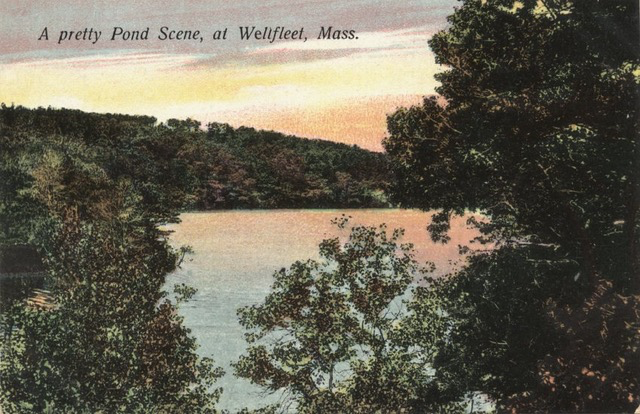
Having established improved ways to reach the ponds and identified the ponds as uniquely important amenities for residents, summer visitors, and tourists, the town’s focus after World War II shifted to promoting the ponds as valued recreational amenities and to safe-guarding and preserving their intrinsic natural qualities. Reports from 1947 show the Board of Park Commissioners asking to “be given sufficient appropriation to defer all expenses relating to beaches, parks, town landing and recreational areas”, while also noting that “much of the town’s income is derived from its attraction as a summer resort and it is deemed by the selectmen a wise expenditure.” That same year, the town voted to spend $500 to build “a permanent sluiceway connecting Gull Pond with Higgins Pond”. Then, in a notation from a year later: “We are proud to report that the new park at Long Pond seemed to find great favor with both our own residents and summer visitors, and was used extensively all the summer months.”
Enhancement of pond facilities continued in 1948 with the town securing a right of way and bathing beach at Duck Pond, and designating it as “particularly for South Wellfleet Residents.” Meanwhile negotiations began to purchase land for town landings at Gull, Great, and Long Ponds, with voters okaying a request for $3,700 for the Great and Gull Pond landings. A few years later, in 1953, town reports described completion of the Gull Pond project as follows: “A real achievement was the acquisition of a five and one-half acre Town Landing at the westerly side of Gull Pond with a pond frontage of four hundred feet. It is proposed to have access to this beautiful area by a town way leading from Gull Pond Road…This area will solve many problems of fresh water bathing and boating on one of our best ponds.” Concurrent with this, the Wellfleet Recreation Committee hired a swimming instructor and offered its first classes at Gull Pond in July and August, serving 165 registered students. Swimming lessons continue to be offered there to this day.
Enhancements in the 1950s continued. Picnic tables were provided at various ponds, a raft was installed on Long Pond and new steps, and boat ramps and beach and road improvements were made to Gull Pond.
By the early 1960s the town added signage to the ponds. One concern was vandalism, and the new signs addressed that. Regulations became of particular importance, as the destruction of benches and tables was costly. In 1965 the town introduced the beach sticker program. It is not clear if ponds were included from the program’s inception. The first year the program raised $10,000.
The success of the enhanced beaches and ponds created its own problems. By the late 1960s the town lamented: “Due to the present enormous influx of summer visitors using our beaches and ponds, daily clean-up patrols, usually very early in the morning, are not only necessary but are proving inadequate …”. Additional facilities became necessary, prompting the town in 1968 to erect a “comfort station” at Gull Pond.
In 1969 it was clear to the selectmen that more parking was needed at Long Pond and Great Pond, with the caution that, “parking must be limited because of possible pollution.” In the ‘70s the town reported the ponds to be “more popular than ever”, with town leaders pointing out that “The public has been very helpful and ecology minded for which we thank them.”
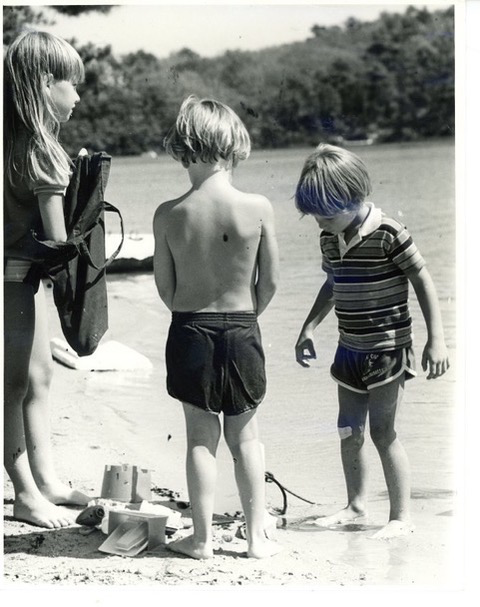
Later, in the Town Annual Report for 1976, the Report of the National Seashore Advisory Committee, noted: “Several problems relating to the use of the ponds within the Seashore were presented to the Commission. A sub-committee was appointed to make detailed study and report to the Commission. This is now in process.” Three years later the town mentioned a follow-up on the sub-committee report of thirty-six pages on the question of Pond Management in Wellfleet. (Note: neither of these reports are available at the town library.)
By 1980, The Wellfleet Recreation Committee began charging fees for its swimming program. It proved to be a money-maker: “The fee system proved very successful generating a significant amount back into the General Fund.” In 1983, an enhancement of the beach sticker system was voted in, authorizing “the Board of Selectmen to issue non-transferrable vehicle identification municipal permits for the exclusive use of parking lots at all town beaches and use of the disposal area, at no charge to residents and taxpayers and $12.00 to persons paying for accommodations in Wellfleet, 80% of the proceeds to be placed in the Beach Fund and 20% to be placed into the general revenue”.
Monetizing the ponds continued in the 1980s as the town voted “to authorize the Board of Selectmen to enter into a one-year lease agreement with Jack’s Boat Rentals for the sum of seven hundred and fifty dollars annually to continue to provide space at town owned and operated landing at Gull Pond for the rental of boats during the time such landing is supervised and open to the public.”
The popularity of the ponds raised ongoing issues, as the town struggled to balance access and preservation. In 1984 the town voted “to have the Town enforce a No Parking Zone on Cahoon Hollow Road between the Great Pond Parking Lot and Old County Road to protect Dyer Pond from extraordinary congestion.” Parking tickets became a new source for revenue, as the town collected more than $8,000 for parking offenses in the late 1980s.
Also in the 1980s, the town’s new Conservation Commission began addressing pond needs and concerns. In 1987, the commission noted that they “will require hearings for any proposals to lime the ponds …” and “with the cooperation of the Selectmen, new regulations for parking at the Sluice were passed to prevent abuse of that section of Gull Pond and surrounding wooded area.” The following year a new town program, “The Beach Guard Captains,” patrolled Wellfleet waters including the ponds and Sluiceway. It is not clear what the responsibilities were of these captains or how long this program continued. Erosion control was also noted as a concern for both Gull Pond and Long Pond swimming areas.
Reports from the early 1990’s show the Select Board identifying more challenges it faced with the ponds. Among those were erosion and the need for rest rooms and off-road parking at Long Pond, and the “the need to protect our lovely fresh-water ponds which are sorely stressed in Summer.” By the middle of the 1990s, a new parking area had been approved for Long Pond, along with plans for construction of rest rooms there. Meanwhile, Duck Pond continued to face “parking issues and overuse,” with the board lamenting, “a lasting solution has yet to be found”, and the Park Commission declaring: “We consider our parks and recreation areas to be no less than our town’s treasures and will continue to maintain them accordingly.”
By the end of the 1990s, the Select Board had appointed a Coastal and Pond Access Committee “to monitor access to Town Landings and to make major recommendations relative to maintaining access.” The concern was that the public had lost historic access to beaches and Great Ponds. The first task was “to identify those landings and accesses that appear to have succumbed to obscurity, private encroachment or disuse.” The committee identified 58 of these access points, and recommended action on 15. It is not stated how many of these access points were on ponds, but the committee did note: “Our ponds and beaches are the reason so many come to Wellfleet.” By the end of the 1990s the Committee reported that it had erected a dozen new Town Landing signs. The exact language on the signs is not reported, but presumably the signs made clear the right of public access at the landings. Reports from this time also describe a National Park Service-funded groundwater and surface water modeling project of Gull and Duck Ponds. Results from that project did not appear in subsequent annual reports.
Concluding perspectives:
In contrast to the emphasis on improving access and conditions for viewing the ponds dominating the pond-related elements of town reports from the early 20th century, reports from the latter half of the century featured greater interest in equipping the ponds as desirable recreational amenities through the provision of access, picnic tables, parking, rest rooms, rafts, and enhanced beaches. As the town approached the new millennium, leaders increasingly concerned themselves more with “abuse” and “overuse” of the ponds, impacts of erosion of their bordering lands, and the quality of the water in the ponds. The emerging challenge of finding the balance between the pleasures provided by the ponds and the value they brought to the town, with the need to protect them as the unique resource they are is a world we are still living in today.
Note: The Town and the Ponds in the 21th Century (2000-2025) will be added in 2026.