
On the website of the Wellfleet Historical Society you can find three photographs labelled “Ice-House-Long Pond, Wellfleet.” The now vanished ice house depicted a common use of Wellfleet Ponds, now forgotten. The photographs are undated, but one of the three is identified as being taken by L.A. Covell and the other two appear to be taken by him as well. Lornaus Alden Covell (1867-1914), was a professional photographer, born in Wellfleet, so we can assume that the pictures were probably taken sometime between 1887 (or so) and 1914.
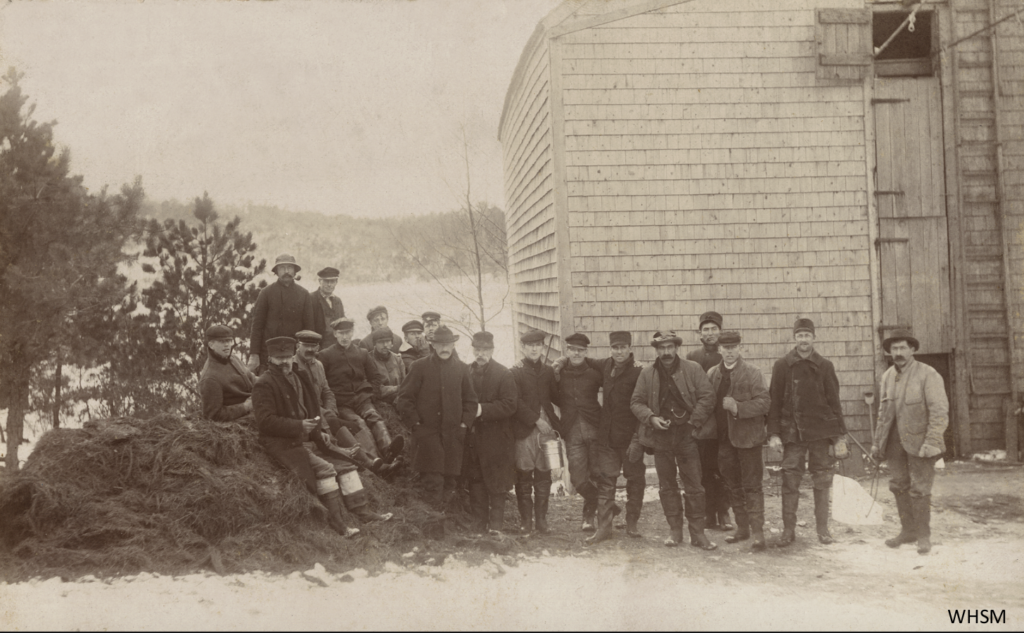
Image courtesy of Wellfleet Historical Society & Museum
Although few details about the ice house are included on the Historical Society record of the photographs, we can draw some conclusions. The pictures show us an industrial ice harvesting operation, not an ice house that might have served the needs of an individual family. Those domestic structures, typical of the 18t and the early 19 century usually featured small buildings constructed over a hole in the ground which held ice. In those days average people would preserve their food through such methods as drying, smoking, or salting. The underground ice-houses were typically for the elite. The Massachusetts ice-harvesting industry, which was developed under the guidance of Francis Tudor (1783-1864) in the early 19th century, shipped ice world-wide, as far as India. In the 18th century ice-harvesting for the use of elites had been a somewhat haphazard process, without specific tools or processes. Tudor’s employee, inventor Nathaniel Jarvis Wyeth (1802-1856), changed this. He developed special tools for ice harvesting, such as a horse-drawn ice-cutter which aided in the production of uniform blocks of ice which could be more easily stored and shipped. Wyeth also invented the above-ground ice-house with double-walls for insulation. Straw or sawdust typically provided insulation between the ice blocks. It is a version of that ice house which appears in the photos of Long Pond.
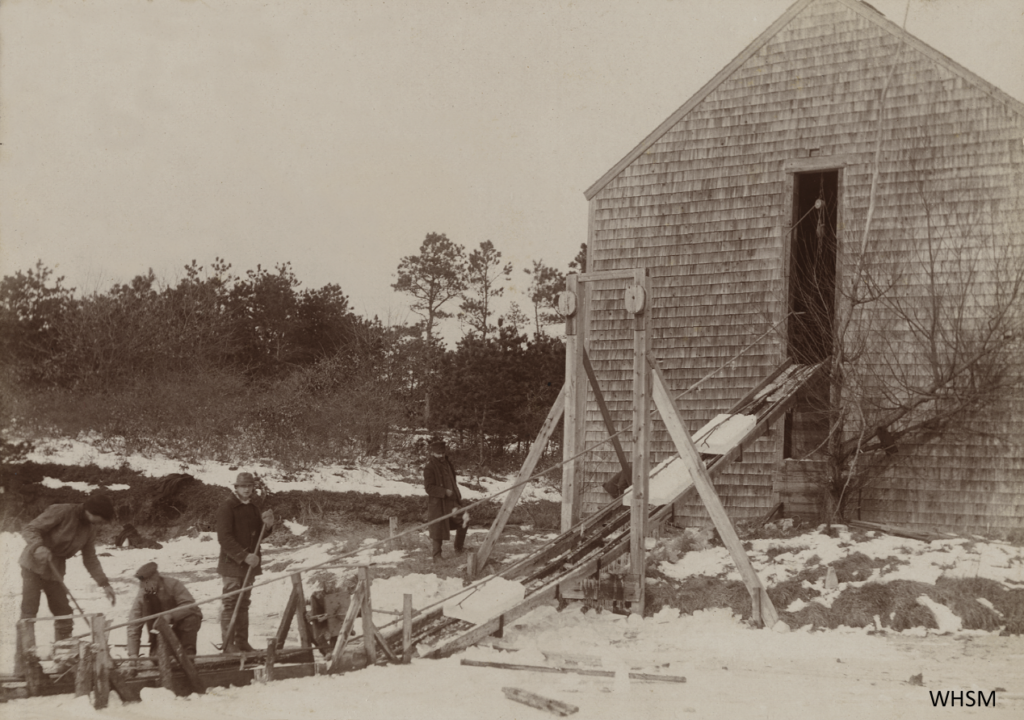
Image courtesy of Wellfleet Historical Society & Museum
The commercial ice-harvesting business depended on Massachusetts kettle ponds for ice. Kettle ponds, like Thoreau’s Walden Pond and Wellfleet’s Long Pond, were valued by those in the ice harvesting business because the! produced particularly clear ice. To access the ice entrepreneurs like Tudor would purchase smaller ponds directly, and benefit from the laws governing the public use rights of “Great Ponds” of more than 10 acres. Although Tudor had a home in Sandwich, his business does not appear to have included ice from Cape Cod ponds.
Like harvesting cranberries, hay, or other agricultural products, ice harvesting depended on specific conditions for the crop to mature. Once ready, the harvest happened quickly, with crews of men assembled for a short, intense period of work. Once the ice-house was full, harvesting ended. The Provincetown Advocate regularly reported on the ice industry in Provincetown, although not in Wellfleet. But we can learn from accounts of the Provincetown experience.
By early January 1879, for example, two commercial Provincetown ice houses held ice blocks between eight and nine inches thick. One house housed 600 tons of ice, the other 1,200 tons. Each of these concerns hired teams of about twenty-five men to do the harvesting. In late January 1918 The Advocate reported on the harvest: “Most of the cutting gangs ceased operation—with houses filled—late last week. The Adams plant-the largest by far in town-was filled to capacity limit on Friday noon last. The best crop, size and quality known to be taken here heretofore is surpassed for the intake of the past fortnight.” But the conditions were not ripe for the ice crop every vear. In February 1947 The Advocate lamented that only an inch of ice had formed and there should be six or seven inches for ice-cutting “which probably won’t be this winter.”
The Long Pond ice house probably supplied both individual households and local businesses. Ice companies typically delivered to homes and customers had ice boxes in their kitchens to hold the ice. By the beginning of the 20t century, most American households had ice boxes, and those continued to be in wide use until the electric refrigerator became affordable for most Americans in the 1940s. The ice in the Long Pond ice house lasted from one winter to the next.
After harvesting the ice crops, the commercial ice companies spent the rest of the vear delivering the ice to their customers. Ice company drivers would bring the ice directly to the consumer’s kitchen ice box.
While we can piece together the general story of the Long Pond Ice House, many questions remain. Who were the twenty men assembled in the photo? When and why was the ohoto taken? Presumably the men are the crew who cut the ice that year. Who hired them? What were they paid? Who invested in the construction of the ice house? How long was it in business? Is the metal lunch box a clue to some of these questions? How about the range of caps and hats the men are wearing? We are still seeking answers, but the ice house photos remind us that Wellfleet’s ponds were not only sites of beauty and recreation, but industry as well.